
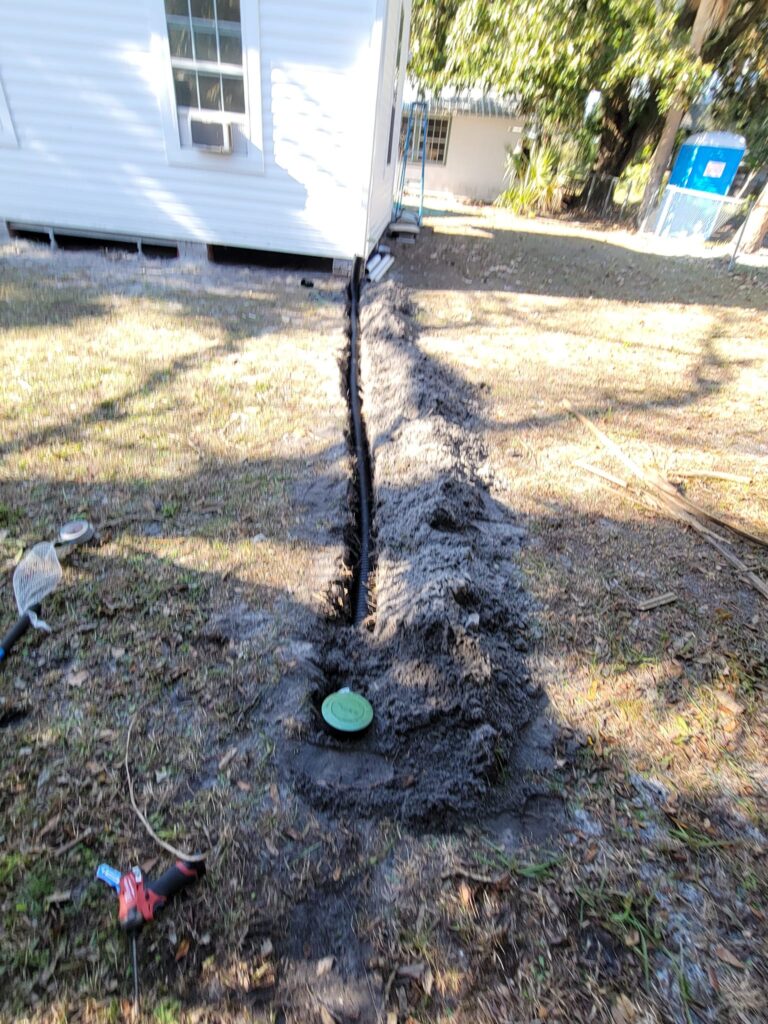
Walk across your yard 24 hours after a heavy Florida Panhandle rainstorm. If your boots sink into spongy turf and water still pools heavily against the base of your foundation slab, your property has a severe water-management failure. When intense, fast-moving storms dump massive volumes of rain onto a relatively flat residential lot, the soil eventually reaches maximum saturation and loses its physical ability to absorb any more moisture.
The water simply sits.
That standing water does not just ruin your landscaping. It exerts immense hydrostatic pressure directly against your concrete foundation, eroding the compacted soil that supports your footings and inviting aggressive pest infestations into the damp perimeter of your home. To permanently break this cycle, you must install proper underground drains in Crawfordville, FL. However, burying a random plastic pipe in the mud will not fix a saturated yard. You must match the drainage system to the exact source of the water.
Diagnosing the Source: Roof Runoff vs. Surface Water
Homeowners frequently assume that any pipe buried in the yard is automatically a French drain. That dangerous technical misunderstanding can lead to completely ineffective installations.
The goal dictates the exact pipe required.
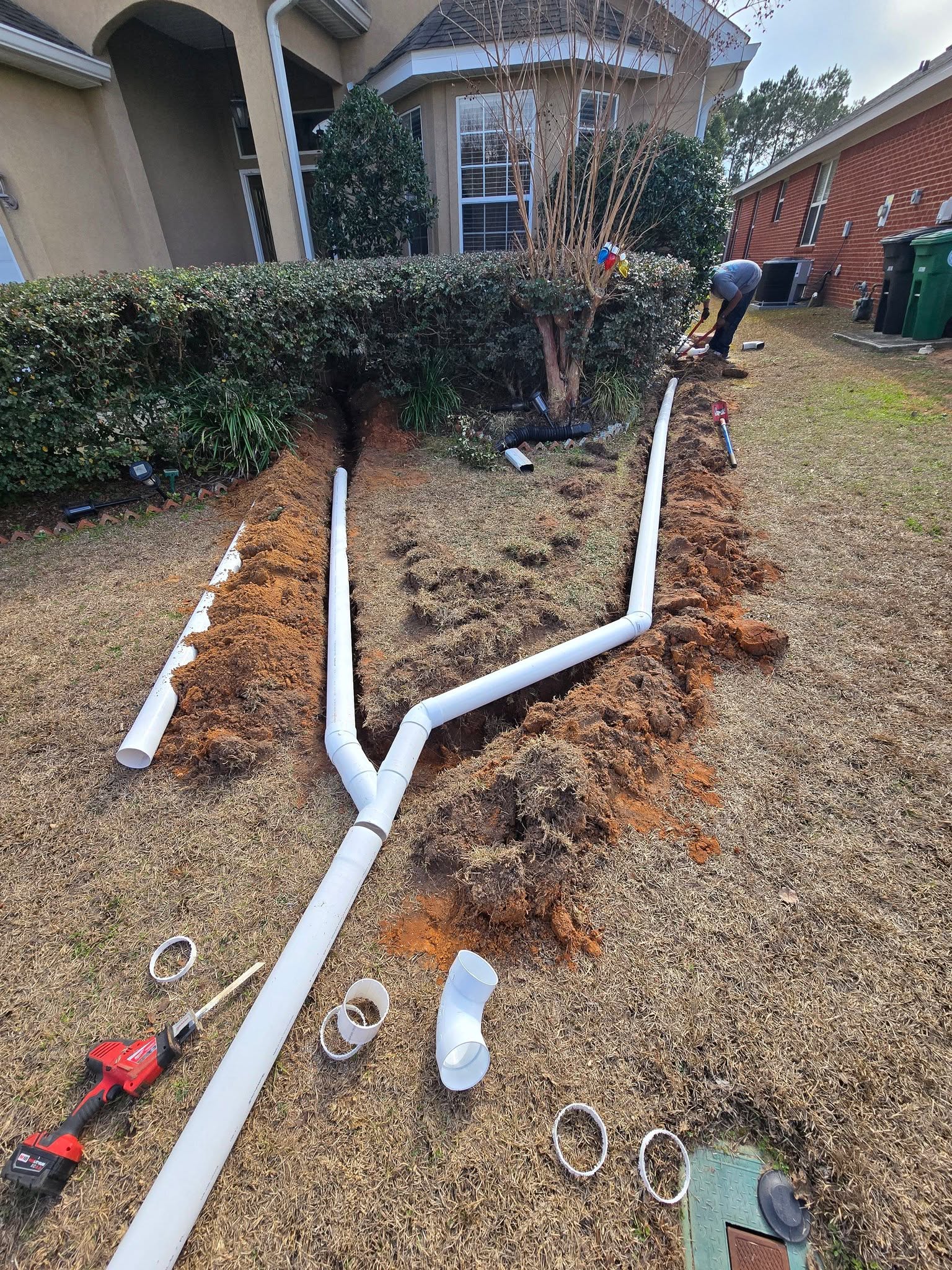
If your primary problem is that your seamless gutters are catching hundreds of gallons of roof runoff and dumping that high-velocity water directly into a single flowerbed, you don’t need a collection trench. You need relocation. That requires solid, non-perforated underground drainage pipes attached directly to your downspouts. These closed pipes lock the aggressive water inside a smooth channel and rapidly transport it 20 or 30 feet away to a lower elevation before safely discharging it.
Conversely, if the problem is a low-lying section of your lawn that naturally collects ambient rainwater and turns into a stagnant swamp, a solid pipe is useless. The water has no way to get inside. That specific scenario requires a French drain to actively pull the moisture out of the surrounding saturated mud.
The Physical Mechanics of a French Drain
A French drain is a highly engineered subsurface collection system designed specifically to combat localized ground saturation. Gravity does the heavy lifting.
The system relies on a carefully excavated trench that is mathematically sloped to ensure a continuous downward pitch. The trench is lined with professional-grade permeable filter fabric and partially filled with washed gravel. A perforated pipe—meaning a pipe with hundreds of small holes drilled along its length—is laid on top of the gravel bed, and more gravel is packed around it. Finally, the fabric is wrapped over the top to fully enclose the rock, and the trench is covered with soil and grass.
When you evaluate a french drain in Crawfordville, FL installation, the physics are straightforward. As the surrounding yard becomes saturated during a storm, the excess groundwater naturally seeks the path of least resistance. It seeps through the topsoil, passes cleanly through the filter fabric, trickles down through the porous gravel, and enters the perforated pipe. Once the water is inside the channel, gravity immediately pulls it away from the problem area.
The Gutter Discharge Bottleneck
Catching water at the roofline is only half the water-management equation. If your gutters work perfectly but your downspouts discharge that heavy volume directly against your exterior walls, you have essentially moved the water off your shingles only to drive it straight into your foundation.
Water requires a designated escape route.
Dumping high-pressure roof runoff directly into a perforated French drain usually backfires catastrophically. The sheer volume and velocity of water dropping from the roof will blow out through the perforations in the buried pipe, completely saturating the exact section of the yard you are trying to keep dry. Downspout discharge must be routed through solid underground pipes, keeping the heavy volume completely isolated from the surrounding soil until it reaches the final, safe discharge point.
Florida Panhandle Grading and Gravity
Water will not flow uphill. Every successful underground drainage system relies on a precise, mathematically calculated downward slope to keep the liquid moving aggressively toward the exit.
Coastal plains are notoriously flat.
Depending on the property, establishing a functional slope requires careful trenching and evaluation. If a residential lot has negative grading—meaning the soil actively slopes backward toward the house—surface water will constantly run straight into the foundation walls. When evaluating the need for a french trench drain in Crawfordville, FL, homeowners frequently request that the system be physically trenched deep enough to overcome this terrain and force the water away from the structure.
System Clogs and Debris Management
Gutters collect more than just liquid rainwater. They catch dense oak leaves, abrasive asphalt roof grit, pine needles, and broken twigs.
If this solid organic debris washes down the vertical downspout and enters a buried horizontal pipe, it creates an impenetrable dam. When an underground line chokes on rotting leaves, the water backs up instantly. Because the pipe is buried, you cannot easily reach the clog. The intense pressure of the trapped water will usually blow the downspout completely off the wall adapter, forcing raw runoff to spill directly down your siding.
Whenever we connect downspouts to underground lines, we have to consider debris management. Because Bradley’s Custom Gutters also provides professional gutter guards, seamless gutter installations, and comprehensive gutter cleaning, we can address the debris problem directly at the roofline. Stopping heavy leaves before they enter the downspout ensures only clear rainwater reaches your buried drainage system.
Observable Warning Signs of Failing Drainage
Do not wait for water to breach your crawlspace or flood your living room before evaluating how your property sheds runoff. Walk the perimeter of your home after a heavy downpour and look for these concrete physical indicators:
- Standing Puddles: Large pools of water remaining in the yard or next to the foundation 24 hours after the rain has completely stopped.
- Mulch Trenches: Deep divots or trenches carved into the soil directly beneath a downspout opening.
- Mud Splash: Heavy brown mud splashed high onto your brick, stucco, or vinyl siding near the foundation corners.
- Spongy Turf: Yard areas that feel soft, sinking, or swampy when you walk on them days later.
- Sidewalk Algae: Thick green algae or moss growing heavily across concrete walkways, indicating a permanent path of slow-moving surface runoff.
The Bradley’s Custom Gutters Process
We are a local, family-owned and operated company serving the Florida Panhandle and South Georgia since 2021. We do not just bury plastic tubes blindly and hope the water disappears.
We evaluate the entire water-management circuit.
When we arrive at a Crawfordville, FL, property, we observe natural water-flow patterns, inspect roofline runoff, and identify exactly where water is collecting. We then develop a property-specific drainage design. We select the correct materials—whether you need a perforated French drain to collect stagnant lawn water, or solid underground routing to relocate aggressive gutter discharge—and trench the system to ensure the gravity slope is flawless.
Secure Your Foundation Before the Next Storm
Ignoring heavy water pooling at the base of your home lets aggressive moisture dictate your foundation’s structural health. Eroded soil, compromised concrete footings, and localized yard flooding are expensive secondary consequences of a drainage system that cannot handle the environment.
The solution requires capturing water, establishing a flawless gravity slope, and routing the volume safely away from your home’s footprint.
Bradley’s Custom Gutters provides comprehensive exterior water-management services across Crawfordville, FL, and the surrounding communities. Call (850) 879-6111 today to request your free quote, and ensure your property is permanently protected from aggressive standing water.
Will Tree Roots Destroy My Underground Drainage System?
Roots aggressively seek out moisture and oxygen. If an underground system relies on thin, unsealed corrugated piping, tree roots will eventually crush the plastic or infiltrate the seams. Proper trenching, heavy-duty pipe selection, and protective fabric barriers deter root intrusion and keep the water channel intact.
Does a French Drain Require a Massive Yard Excavation?
No. A standard French drain trench is usually narrow and highly targeted. We carefully excavate only the path needed to capture pooling water and establish the gravity slope, minimizing disruption to your existing landscaping.
Can I Just Attach a Flexible Black Plastic Hose to My Downspout?
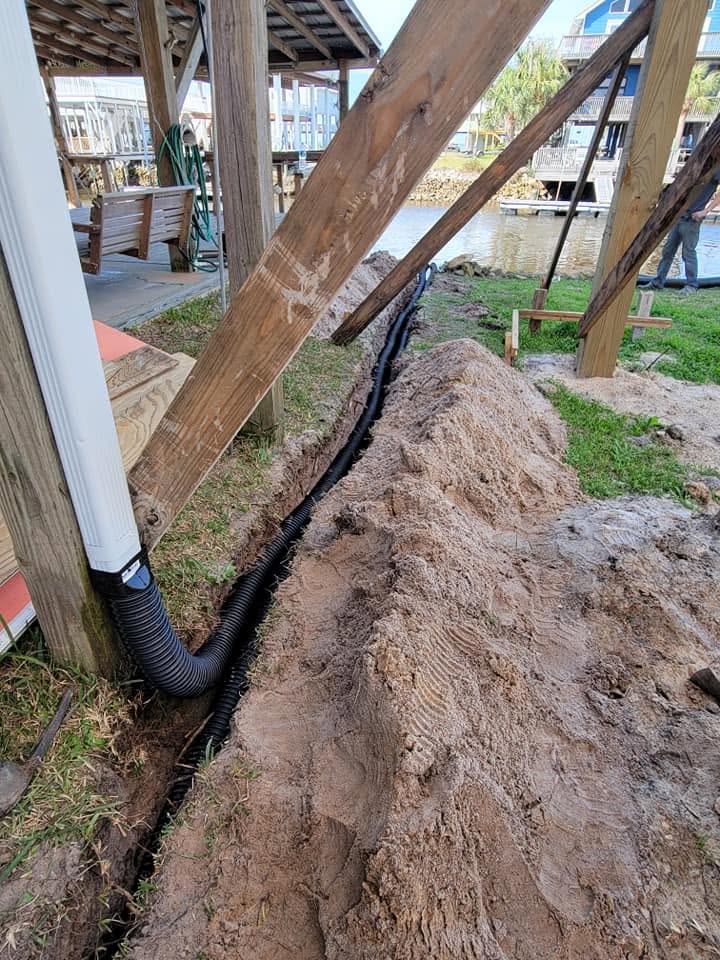
Laying thin corrugated plastic piping on top of the grass is a temporary, easily damaged band-aid. Unburied corrugated pipe is easily crushed by lawnmowers, degrades rapidly in heavy UV sunlight, and creates a massive tripping hazard in your yard. A professionally trenched underground system provides permanent, structural routing that is completely invisible from the surface.
Where Does the Water Go When It Reaches the End of the Pipe?
Moving the water away from the house requires a designated exit strategy. Depending on your property’s slope, the end of the line may simply emerge from the side of a lower hill to let the water spill naturally. On flatter lots, we frequently install a pop-up emitter—a covered mechanical valve installed flush with the lawn grass that opens under water pressure to release the volume safely away from the home.